Automated Security Benchmark - Auditing and Remediation
Why should this role be applied to a system?
There are three main reasons to apply this role to systems:
Improve security posture
The configurations from the adopted benchmark add security and rigor around multiple components of an operating system, including user authentication, service configurations, and package management. All of these configurations add up to an environment that is more difficult for an attacker to penetrate and use for lateral movement.
Meet compliance requirements
Some deployers may be subject to industry compliance programs, such as PCI-DSS, HIPAA, ISO 27001/27002, or NIST 800-53. Many of these programs require hardening standards to be applied to systems.
Deployment without disruption
Security is often at odds with usability. The role provides the greatest security benefit without disrupting production systems. Deployers have the option to opt out or opt in for most configurations depending on how their environments are configured.
What is security hardening?
The content delivered is based upon either one of the two major contributors to the security best practices in the IT industry.
Center for Internet Security (CIS): CIS
A global IT community of experts helping to build, document sets of benchmarks to produce industry best security practices. CIS Benchmarks are vendor agnostic, consensus-based security configuration guides both developed and accepted by government, business, industry, and academia.
or
Security Technical Implementation Guide (STIG): STIG
From the Defense Information Systems Agency (DISA)
The STIG is released with a public domain license and it is commonly used to secure systems at public and private organizations around the world.
Both are well known and respected benchmarks created for the industry to assist in achieving recognised compliance (e.g. PCI DSS, HIPAA, SOC2, NIST) and adopting security best practices.
What is provided?
The content provided is open source licensed configurations to assist in achieving or auditing compliance to one of the benchmark providers listed above.
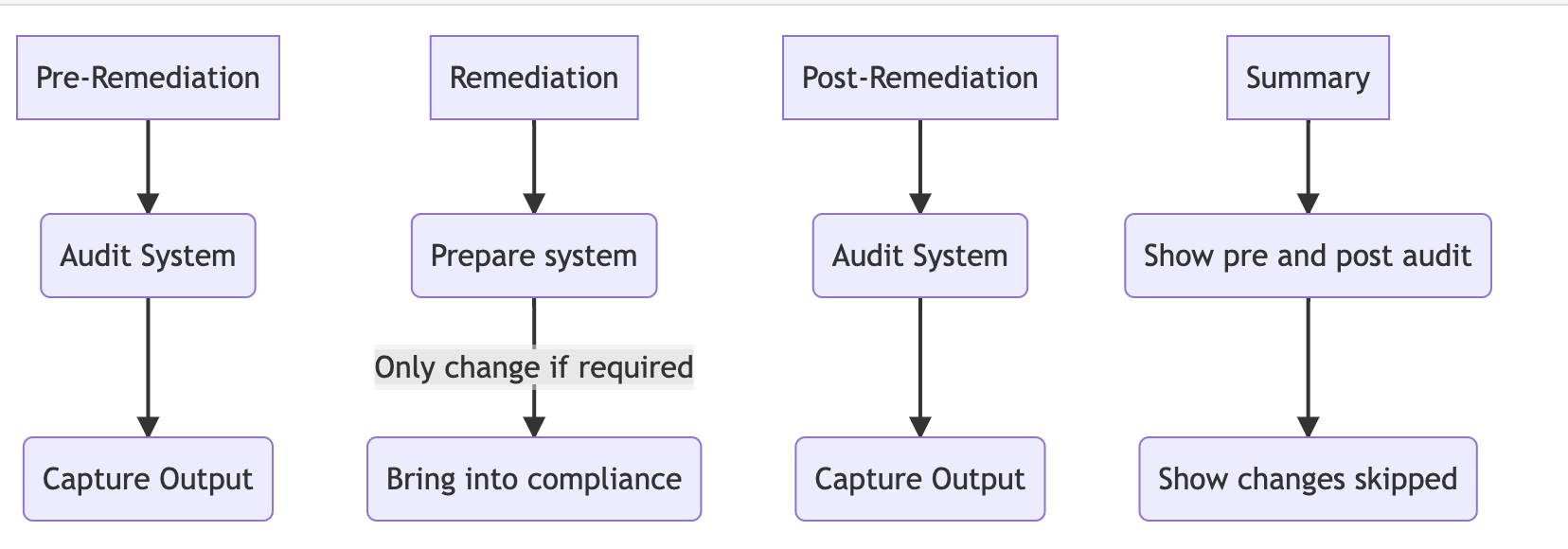
This consists of two components
Audit
runs a small single binary on the system written in go called goss
enables you to very quickly scan your host and output the status of compliance for your host.
Remediate
Has the ability to run from a central location using the configuration management tool ansible.
Can assist with bringing your host into compliance for the relevant benchmark.
Both can be run alone or inconjunction with each other.
How is this written?
We analyze each configuration control from the applicable benchmark to determine what impact it has on a live production environment and how to best implement a way to audit the current configuration and how to achieve those requirements using Ansible. Tasks are added to the role that configure a host to meet the configuration requirements. Each task is documented to explain what was changed, why it was changed, and what deployers need to understand about the change.
Deployers have the option to enable/disable every control that does not suit their environments needs. Every control item has an associated variable that can be used to switch it on or off.
Additionally, the items that have configurable values, i.e. number of password attempts, will generally have a corresponding variable that allows for customization of the applied value. It is imperative for each deployer to understand the regulations and compliance requirements that their organization and specific environments are responsible for meeting in order to effectively implement the controls in the relevant benchmark.
Development Process
Branches
devel - This is the default branch and the working development branch. Community pull requests will pull into this branch
main - This is the release branch
Lifecycle of releases and branches
While Remediate and Audit are individually managed processes, nevertheless, some of the content is linked. There are occasions where both need updating or just one of them.
As a rule, we try to abide to the following lifecycle process for branches and releases that include ansible-galaxy sync updates. Being community, we have direct customer requests and requirements that takes priority in releases.
devel branch - Staging area for bug fixes, PRs and new benchmarks.
We aim to get majority of PRs merged to devel between 2-4 weeks.
Main branch - Merge of devel in to main.
This is dependent on the severity and impact of issues closed. Routinely, a release alignment is every 8-12 weeks (sometimes much quicker).
New benchmark version release.
Once a new benchmark gets released by the provider, we aim to get to a new tagged release between 2-4 weeks.
This is also where the releases are sourced and linked with ansible-galaxy.